
Low Water Paddling: Grounding, Rock Gardens, and Scouting Channels
Techniques for navigating low-flow river conditions, protecting boat hulls from hidden boulders, and identifying deep navigable channels.
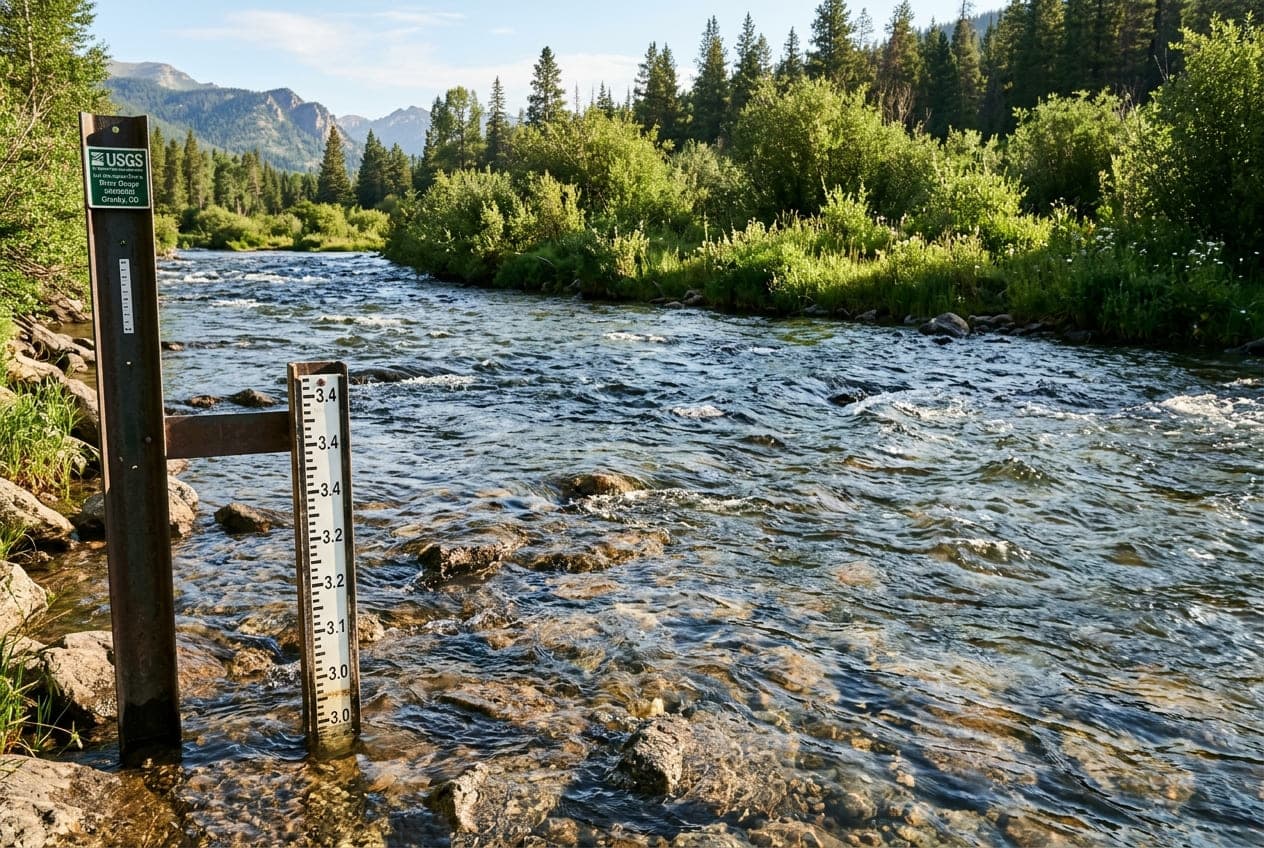
While high water commands immediate respect due to violent rapids and swift currents, paddling during low river flows introduces a completely different set of physical challenges.
When summer heat sets in or regional rainfall subsides, USGS streamgages often drop into the bottom 10th or 25th percentiles (ClearGauge's "Low" flow verdict). Navigating low water requires finesse, quick channel reading, and specific boat handling techniques to avoid grounding and hull damage.
The Physical Realities of Low River Flow
When discharge drops significantly below median baseline levels, the river undergoes several structural changes:
- Compression of Navigable Channels: In normal flows, water covers the full width of the channel bed. In low flows, water funnels into narrow slots, bedrock fissures, or shallow braided gravel paths.
- Exposed Obstacles: Submerged boulders that normally generate smooth green standing waves become exposed "pillow" rocks or jagged obstacles capable of puncturing hulls.
- Slower Transit Times: Without the propulsion of high-volume current, a trip that normally takes three hours at medium flow can take five or six hours at low flow due to constant flatwater paddling and maneuvering around obstacles.
Reading Shallow River Channels: The Downstream "V"
The most fundamental river reading skill for low-water navigation is spotting the Downstream "V":
- Downstream "V" (Water Funnel): As water flows between two shallow boulders or gravel bars, it converges into a smooth, dark, deep channel shaped like a "V" pointing downstream. Always aim for the point of the downstream V.
- Upstream "V" (Rock Marker): Water hitting a submerged boulder or obstacle splits around both sides, creating a disturbance shaped like a "V" pointing upstream. Hitting an upstream V guarantees an immediate collision with a rock.
The "Horizon Line" at Low Water
At low flows, small drop-offs, ledges, and riverbed transitions become sharper. When approaching what looks like a flat horizon line across the river, identify the lowest notch where water pours through with the cleanest depth before committing.
Boat Handling and Hull Preservation in Shallow Water
1. Shift Weight to Free Grounded Hulls
If you feel your kayak or canoe scrape bottom or get hung up on a shallow gravel bar:
- Do not lean upstream (leaning upstream catches the current against your upstream gunwale or deck, instantly flipping the boat).
- Lean slightly downstream, plant your paddle blade on the rock or gravel, and use short hip-snaps to slide off the obstruction.
2. Micro-Ferrying Between Rock Gardens
In tight, low-flow boulder gardens, charging straight downstream will often drive your bow into a dead-end rock trap.
- Use back-ferrying (angling your boat away from the obstacle and taking light backward strokes) to slow your downstream descent.
- This buys you critical seconds to align your bow with the next clear slot before entering it.
3. Wading and Line Tracking (Lining)
If a drop looks excessively bony or blocked by shallow bedrock ledges, do not risk damaging your boat or injuring your ankles.
- Step out onto dry gravel or shallow calm water.
- Attach a painter line to the bow and stern, and "line" your boat down through the drop while walking safely along the bank.
Respecting Aquatic Ecology During Low Water
Low flow conditions place extreme environmental stress on river ecosystems:
- Shallow water warms rapidly in the summer sun, reducing dissolved oxygen levels.
- Fish congregate in isolated deep pools where they are vulnerable to stress.
- Avoid dragging boats across exposed gravel bars during spawning seasons (such as autumn for brown trout and spring for rainbow trout), as boots and hulls can crush sensitive redds (egg nests).
Want to see this in action? Check real-time river conditions near you.
Explore All Rivers →