
River Hydraulics Explained: Holes, Pour-Overs, Hydrolocks & Escaping Keeper Reversals
A comprehensive guide to river hydraulics: how holes and pour-overs form, smiling vs frowning reversals, boil lines, and life-saving swiftwater escape techniques.
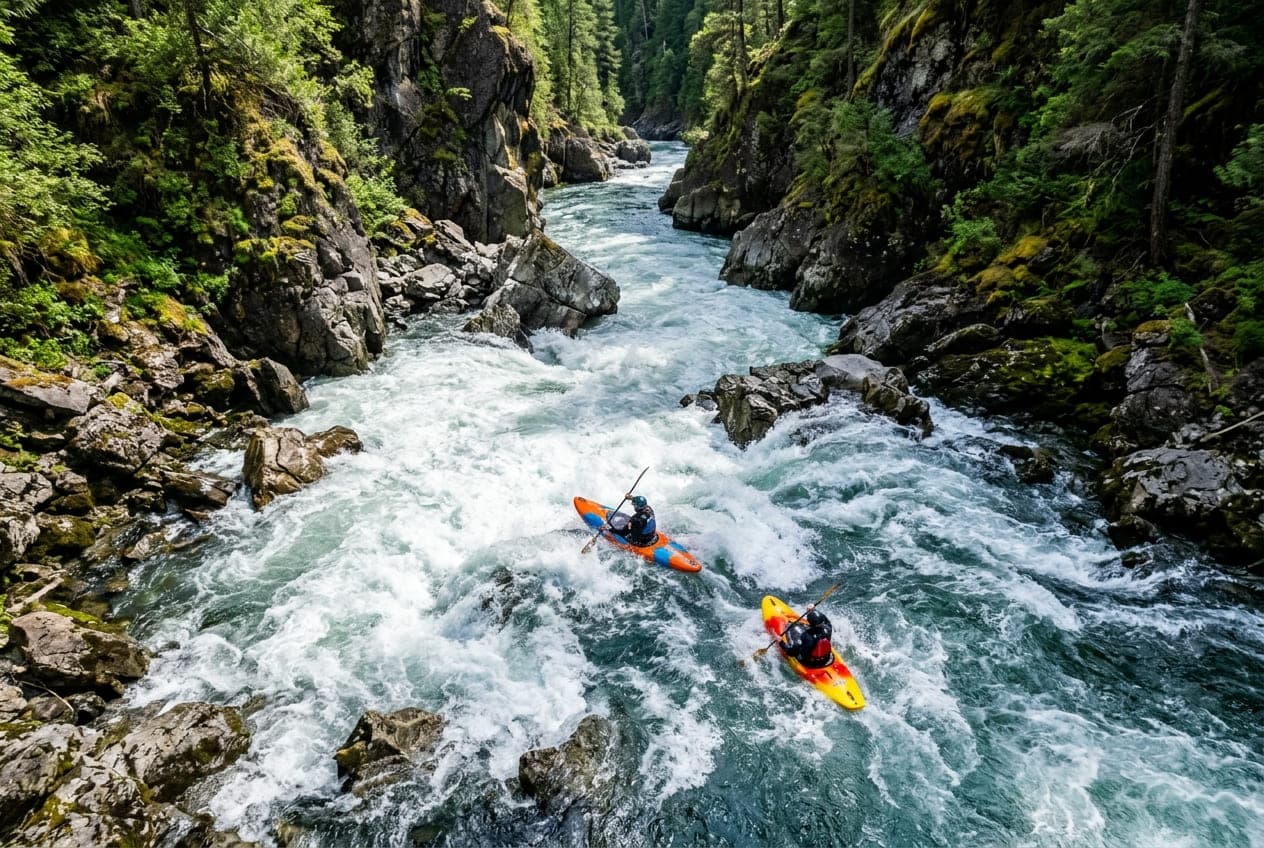
In moving water, nothing inspires more awe—or more terror—than a roaring river hole. Also known as a hydraulic, reversal, or stopper, these recirculating features are among the most dynamic and misunderstood phenomena in river hydrology.
For whitewater kayakers and playboaters, an open, bouncy hole is an exhilarating playground for blunt flips and cartwheels. But for an unsuspecting rafter, packrafter, or swimmer, a deep, recirculating ledge hydraulic can become a violent water trap that pins gear and defies buoyancy.
Understanding the physics of how hydraulics form, how to identify dangerous "keeper" holes from the riverbank, and the counter-intuitive hydrodynamics of escaping one can save your life. Here is the complete guide to river hydraulics.
Anatomy of a River Hole: The Physics of Recirculation
A hydraulic forms whenever water accelerates over a submerged obstacle (such as a boulder, ledge, or bedrock shelf) and plunges into a deeper pool below:
- The Pour-Over (Supercritical Flow): Water accelerates down the backside of the submerged obstacle at high velocity. Because it is moving faster than the surrounding downstream water, it creates a localized vacuum or depression directly behind the rock.
- The Hydraulic Jump: To balance the kinetic energy and fill this depression, downstream water rushes backward upstream toward the obstacle. This upstream-moving surface water is called the backwash.
- The Boil Line: The boundary downstream where the recirculating backwash meets the normal downstream flow. If you look at a hole, the boil line is the distinct line of mounding, bubbling water where bubbles rise and divide—some water recirculating back upstream into the trough, and some flushing downstream.
- The Outwash: The deep, solid green laminar water moving along the riverbed beneath the frothy surface aeration.
       Upstream Flow ───────► [ Submerged Rock ]
                                      \
                                       \ (Pour-over)
   Downstream Flow ◄────────────┐       \
     (Outwash on riverbed)      │        ▼
                                └──────► [ Trough / Hole ] ◄── (Backwash)
                                             ▲                  │
                                             └──── Boil Line ───┘
The Danger of Aeration: Why PFDs Don't Float as Well
Why are hydraulics so difficult to swim out of compared to flatwater? The answer is density and aeration.
When water plunges into a hydraulic trough, it traps vast amounts of atmospheric air. The resulting water-air mixture is white, foamy froth:
- Pure river water has a density of approximately 1.0 g/cm³ (62.4 lbs/ft³).
- Highly aerated whitewater in a violent hydraulic can drop to a density of 0.5 to 0.6 g/cm³.
- The Consequence: Your Personal Flotation Device (PFD) and your body rely on water displacement for buoyant lift. In water that is 40% air bubbles, your buoyant lift is nearly cut in half. Even with a high-flotation USCG Type V life jacket, your head may struggle to clear the surface of the foam.
Smiling vs. Frowning Holes: How to Spot a "Keeper"
Not all hydraulics are created equal. When scouting a rapid from the shore, experienced river runners analyze the shape of the hydraulic's lip and boil line:
1. The "Smiling" Hole (Flushing Hydraulic)
- Visual Shape: Curved like a smile—the center of the hydraulic is positioned slightly upstream, while the left and right corners bend downstream.
- Hydrological Action: Because the sides angle downstream, water in the center naturally shoots outward toward the edges. If a boat or swimmer drops into the trough, the centrifugal hydraulic forces push them out the sides into safe downstream current within seconds.
- Danger Level: Moderate; generally safe and fun for experienced paddlers.
2. The "Frowning" Hole (Terminal Keeper)
- Visual Shape: Curved like a frown—the center of the hydraulic bows downstream, while the left and right corners curl upstream.
- Hydrological Action: Water rushing back into the trough is funneled toward the center from both sides. There are no open exit windows. Any object trapped inside is sucked into the focal point of maximum downward force.
- Danger Level: EXTREME. Frowning holes—especially those formed below straight-across man-made low-head dams or wide shelf ledges—are notorious killers.
| Characteristic | Smiling Hole | Frowning Hole |
|---|---|---|
| Shape Orientation | Ends sweep downstream (concave downstream) | Ends sweep upstream (concave upstream) |
| Water Exit Path | Flushes continuously out left and right shoulders | Recirculates back into dead center |
| Swimmer Behavior | Automatically ejected into side eddies | Held in recirculating surface loop |
| Scouting Action | Runnable with proper line and paddle speed | Mandatory Portage |
How to Punch Through a Hole
If you are kayaking or rafting and running an aggressive hole is unavoidable:
- Charge with Momentum: Decelerating before a hydraulic is fatal. Accelerate hard on your approach; you need forward kinetic energy to breach the opposing wall of backwash.
- Hit the Weakest Point: Rarely is a hole uniform across its entire span. Aim for the "shoulder" or the lowest point in the foam pile where green water breaks through.
- Execute the "Boof" Stroke: For kayakers, plant a vertical power stroke right at the lip of the rock and launch the bow upward. Keeping your boat's nose flat and dry prevents the bow from diving into the recirculating trough.
- Lean Forward and Keep Paddling: When the foam wall hits your chest, do not lean back. Leaning backward exposes the deck of your boat to incoming water, flipping you instantly. Lean aggressively forward, grab the green outwash with a deep stroke, and pull yourself through.
Self-Rescue: How to Escape a Keeper Hydraulic
If you capsize and get pulled into a recirculating hydraulic, panic is your greatest enemy. Standard swimming strokes will not work against hundreds of pounds of backwash. Follow these professional swiftwater rescue steps:
Step 1: Work Toward the Shoulder (Sides)
Try to swim aggressively toward the left or right banks. If the hydraulic has even a slight gradient, moving toward the edge can catch an eddy line or flush you into calmer water.
Step 2: Look for the Boil Line
If you can see the boil line downstream, attempt to back-stroke over it. Once your torso passes the apex of the boil line, the surface current switches from upstream to downstream, pulling you free.
Step 3: The Counter-Intuitive Escape (Dive Deep)
If the hydraulic is holding you in a perpetual cycle—pulling you into the trough, submerging you, releasing you slightly at the foam pile, and dragging you back—stop fighting the surface:
- Curl into a tight ball (tuck your knees to your chest and protect your head with your arms).
- Do not try to stay on top of the water.
- Because backwash is strictly a surface phenomenon (usually only 2 to 4 feet deep), the heavy, green outwash current along the riverbed is moving downstream at high speed.
- By balled-up submersion, your body drops into the deep laminar outwash on the river bottom. The powerful deep current grabs your body and shoots you downstream past the boil line, popping your PFD to the surface in calm downstream water.
Always Scout When Flow Rates Rise
Hydraulics change character dramatically with fluctuating flow rates. A mild splashy ledge that was an easy Class II ride at 400 CFS can transform into a terminal Class IV keeper hydraulic when the river surges to 1,800 CFS during spring runoff.
Before dropping into any whitewater canyon, check live real-time CFS and gauge height updates on ClearGauge. Match the day's flow rate with updated river guidebooks, never run blind drops, and always scout from the bank when in doubt!
Want to see this in action? Check real-time river conditions near you.
Explore All Rivers →