
Safe Wading in Moving Rivers: The Depth-Velocity Formula Every Angler Must Know
The mathematical formula for safe river crossings, why wading belts save lives, traction sole comparisons, and self-rescue techniques if you get swept.
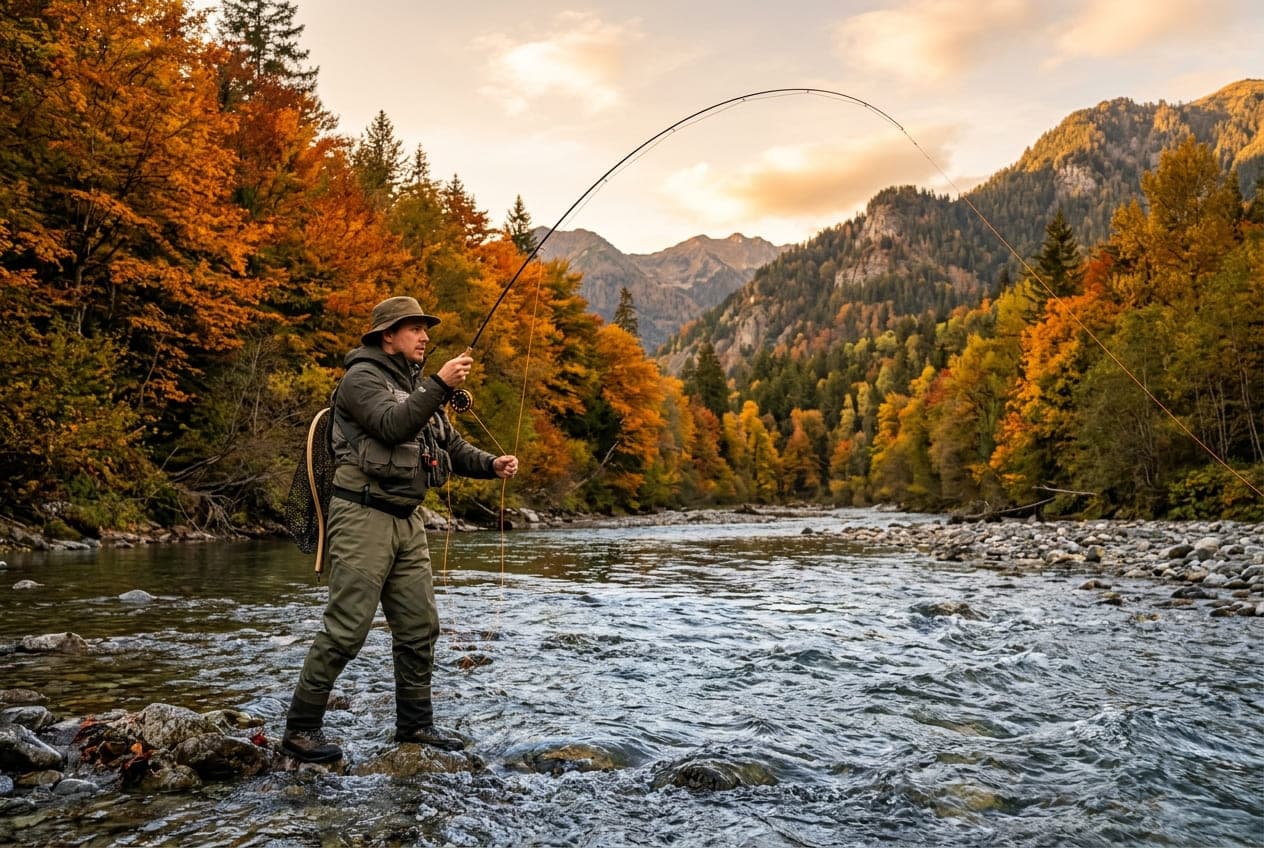
Wading into a moving river to reach an elusive trout seam or cast to a distant pool is one of the greatest pleasures of fly fishing. It is also one of the most deceptively dangerous activities in outdoor sports.
Water is heavy—weighing approximately 62.4 pounds per cubic foot. When water is flowing at 4 to 6 miles per hour, the hydrostatic force exerted against an adult's thighs easily exceeds 50 to 100 pounds of relentless lateral pressure.
Many anglers who consider themselves experienced waders take calculated risks that can easily turn fatal if a single foot slips on a greasy river stone.
Here is the science of wading safety, including the field-tested Depth-Velocity Rule used by swiftwater rescue professionals.
1. The Depth-Velocity Formula: The Rule of 10
Hydrologic engineers and swiftwater rescue teams use a mathematical threshold to calculate whether moving current can safely be crossed by foot:
Depth (Feet) × Velocity (Feet per Second) < 10
If the product of water depth (in feet) multiplied by current velocity (in feet per second) equals or exceeds 10, the crossing is considered unsafe for an unassisted adult.
Practical Field Examples:
- Knee-Deep Slow Current: 1.5 ft depth × 3 ft/sec velocity = 4.5 (Safe to wade).
- Thigh-Deep Moderate Flow: 2.5 ft depth × 4 ft/sec velocity = 10.0 (Marginal / High Risk of Being Swept).
- Waist-Deep Fast Riffle: 3.0 ft depth × 5 ft/sec velocity = 15.0 (EXTREMELY DANGEROUS — Do Not Attempt).
As a rule of thumb: If water is over your knees and flowing faster than a comfortable walking pace, do not attempt to cross.
2. The Wading Belt Myth vs. Reality
A persistent myth among new anglers is: “If you fall into deep water while wearing chest waders, they will fill with water and drag you to the bottom like concrete.”
Physics disproves this myth:
- Water inside waders has the exact same neutral density as the river water surrounding it. It does not “drag you down” like an anchor.
- The Real Danger: If waders fill with water, they add enormous mass and drag. When you try to swim or stand up on a gravel bar, the hundreds of pounds of trapped water make it physically impossible to lift your legs or climb up a riverbank. Furthermore, trapped air in the boots can float your feet toward the surface while your head is pushed downward.
Why a Cinch Wading Belt Saves Lives:
Wearing a snug, wide wading belt buckled tightly around your waist traps air inside your waders, creating positive buoyancy. If you slip into a deep pool, tightly belted waders act like a temporary life jacket, giving you crucial minutes to float onto your back and paddle toward an eddy.
3. Boot Soles & Traction Technology Compared
The geology of riverbeds varies dramatically across the country, from slick freestone boulders to slippery clay ledges:
| Sole Type | Traction on Greasy Boulders | Traction on Mud / Bank Trails | Environmental / Biosecurity Notes |
|---|---|---|---|
| Traditional Felt | Exceptional. Microscopic fibers mesh directly with slick algae and rock surfaces. | Poor. Slides dangerously on wet mud, clay banks, and grass. | Banned in several states (Alaska, Maryland, Missouri) and international destinations due to spreading invasive Didymo (rock snot) and mud snails. |
| Vibram / Sticky Rubber | Moderate. Good on clean rock; slips easily on heavy biofilm/diatom slime. | Superior. Grips dirt, steep muddy banks, and snow securely. | Highly durable, easy to clean, 100% legal in all jurisdictions. |
| Rubber + Tungsten Studs | Excellent. Metal cleats bite through rock slime down to bare mineral stone. | Good. Excellent on mixed terrain; can slide on dry, smooth flat boulders. | Safe for all waters; noisy on bedrock, can scratch aluminum drift boat floors. |
| Aluminum Cleats / Bars | Maximum Available. Soft aluminum alloy bites into hard rock like grease-cutting chalk. | Moderate. Slightly bulky on long overland hikes. | Exceptional for dangerous, heavy freestone rivers (e.g. Salmon River, Delaware River). |
4. Proper Wading Mechanics & Crossing Techniques
When navigating challenging current:
- Always Face Upstream: Stand sideways to the current, presenting the narrow profile of your hips and thighs to the water rather than the broad surface of your chest.
- The Tripod Stance (Wading Staff): Use a collapsible wading staff. Keep two points of contact anchored to the riverbed at all times while moving the third point. Move your feet with small, shuffling steps—never cross one foot over the other.
- Cross Diagonally Downstream: Never attempt to cross moving current by fighting directly upstream or perpendicular to the current. Pick a diagonal trajectory that heads slightly downstream toward a visible shallow gravel bar or calm eddy.
- Partner Wading (The Interlock): If crossing with a fishing partner, stand shoulder-to-shoulder, facing upstream. Lock arms around each other's upper chest or grab the partner's wader belt. The heavier upstream person breaks the current while the downstream person provides stabilizing support.
5. What to Do If You Get Swept
If you lose your footing and are swept into deep current:
- Do Not Panic: Immediately roll onto your back with your face up.
- Keep Your Feet Downstream: Point your toes downstream with your knees slightly bent. If you strike a submerged boulder, your rubber boots will absorb the impact rather than your head or torso.
- Never Try to Stand in Deep Current: Attempting to stand in fast, thigh-deep water is the leading cause of foot entrapment. If your foot wedges between bottom rocks, the current will push your upper body forward, pinning you face-down underwater.
- Backstroke to the Nearest Eddy: Use your arms to backstroke diagonally toward the nearest calm eddy or gentle shoreline, and wait until you reach knee-deep, static water before standing up.
Want to see this in action? Check real-time river conditions near you.
Explore All Rivers →